Two Jesuses, Two Futures: Light and Darkness at the End of History
Dr Celeste Johnson
This article is a comparative theological and eschatological analysis, not a neutral sociological survey. The five major worldviews, with estimated ranges of adherents (out of a global population of 8.2 billion), are Christianity (2.3 - 2.6 billion), Islam (1.8 - 2 billion), Religiously unaffiliated (1.9 billion), Hinduism (1.1 - 1.3 billion) and Buddhism (500 - 535 million).
If we consider the truth-claims of the two largest faith systems, namely Christianity and Islam (which evidently account for more than half of the world’s population) there are only three viable options - either Christianity is true, or Islam is true, or neither are true. The fourth option (of both being true) is eliminated because they are diametrically opposed on the fundamental question of Jesus being crucified on the cross. Christianity is not Christianity without his being crucified, see 1 Corinthians 15:4, whereas Islam is not Islam if Jesus was crucified, see Surah An-Nisa (Chapter 4, Verse 157). [The overwhelming academic consensus on this question is that he was crucified, and this is widely affirmed by mainstream historians.] Another area where they are diametrically opposed is that of Jesus’ statement to be God. In fact, the Qur’an presents a logical dilemma – a dilemma which cannot be true and false concurrently, as shown by the logic below:
● In Qur’an 19:30-31, Jesus is recognised as a prophet but not God (“I am indeed a servant of Allah: He hath given me revelation and made me a prophet.”)
● Qur’an 3:161 states that a prophet does not betray the trust placed in him, specifically regarding misappropriating what belongs to the community.
● Qur’an 5:46-47 claims that the Christian Bible is inspired by God (“And We sent, following in their footsteps, Jesus, the son of Mary, confirming that which came before him in the Torah; and We gave him the Gospel, in which was guidance and light and confirming that which preceded it of the Torah as guidance and instruction for the righteous. And let the People of the Gospel judge by what Allah has revealed therein. And whoever does not judge by what Allah has revealed - then it is those who are the defiantly disobedient.”) Islam later claims the Gospel was corrupted, creating an internal theological tension with these verses.
● In the Gospel, in John 8:57-59, Jesus claimed to be God by calling himself “I AM” (see in Exodus 3:13-14 where Moses said to God, “Suppose I go to the Israelites and say to them, ‘The God of your fathers has sent me to you,’ and they ask me, ‘What is his name?’ Then what shall I tell them?” God said to Moses, “I AM WHO I AM. This is what you are to say to the Israelites: ‘I AM has sent me to you’. In John 8:59, the Jews picked up stones to stone Jesus because he was claiming to be God.
Note that to make sense of the above logical dilemma, Muslim theologians would argue that tahrif (corruption) of Christian texts occurred after Jesus. This creates an internal theological tension unless one introduces a post-Jesus corruption hypothesis, which is not stated in these verses themselves.
Nevertheless, since we are now clear that these two belief systems sit on two fundamentally different mountains (even if they have similar foliage - some characters / prophets appear to be shared between the two narratives), it is quite an interesting investigation to see how each system projects the future / “end times” - a field known as “Eschatology” (pronounced es-kuh-TOL-uh-jee). Both belief systems make eschatological claims involving three characters (so similar foliage) - but are these mountains the same? Or, like the crucifixion and Jesus-God questions, are they diametrically opposed? Let’s jump right in.
The three main eschatological characters, per the Christian narrative, are described in the Book of Revelation (written around 95-96 AD), which is understood to be a prophetic book that points to the “end times”. Being a prophetic book, it is very figurative and uses imagery that is quite often reminiscent of the book of Daniel in the Old Testament. Daniel’s foresight is astonishing (though not addressed in detail here), particularly in the accuracy with which several of his prophecies were fulfilled. These include the exact timing of Jesus’ coming, as well as the nature of certain prophecies set to be fulfilled in future times (which interweave naturally with the prophecies contained in the Book of Revelation).
The first and second eschatological characters, the “Antichrist” and the “False Prophet”, can be found in Revelation chapter 13, and the role of the third character, Jesus, is described in Revelation chapter 19. Below is a summary of the biblical perspective:
● The Antichrist (also known as “the Beast from the sea”) reigns over the world (has authority over every tribe and people) for 42 months, persecutes the saints (makes war with the saints and is given the power to overcome them), and blasphemes God. “All who dwell on the earth shall worship him, whose names have not been written in the Book of Life of the Lamb slain from the foundation of the world.” Rev 13:8. So we see that the Antichrist is indeed a mass-appealing person (with potentially miraculous power - “healed of a deadly wound” according to Rev 13:3) but is ultimately just a deceiver who receives his power from the Evil One.
● The False Prophet (also known as “the Beast from the earth”) is figuratively seen as having lamb-like and dragon-like qualities (think of a wolf in sheep’s clothing). He exercises all the authority of the first Beast in his presence, causes people to worship the first Beast (who had recovered from the deadly wound), and performs miraculous signs like calling fire from heaven and causing those who don’t worship the first Beast to die (Rev 13:15). He then also causes all people to receive the “Mark of the Beast” - which some have interpreted to perhaps be a digital passport aligned with Beast-worship, without which you are excluded from the world’s economy and potentially killed - but which sets you up to be aligned with the Beast and hence an enemy of God, to be separated from Him for eternity.
● Jesus, whose role is probably best summarised here; “Now I saw heaven opened, and behold, a white horse. And He who sat on him was called Faithful and True, and in righteousness He judges and makes war. His eyes were like a flame of fire, and on His head were many crowns. He had a name written that no one knew except Himself. He was clothed with a robe dipped in blood, and His name is called The Word of God. And the armies in heaven, clothed in fine linen, white and clean, followed Him on white horses. Now out of His mouth goes a sharp sword, that with it He should strike the nations. And He Himself will rule them with a rod of iron. He Himself treads the winepress of the fierceness and wrath of Almighty God. And He has on His robe and on His thigh a name written: KING OF KINGS AND LORD OF LORDS.” Rev 19:11-16
At stake is the truth. Two Jesuses, Two Futures: Light and Darkness at the End of History.
“And I saw the beast, the kings of the earth, and their armies, gathered together to make war against Him who sat on the horse and against His army. Then the beast was captured, and with him the false prophet who worked signs in his presence, by which he deceived those who received the mark of the beast and those who worshiped his image. These two were cast alive into the lake of fire burning with brimstone. And the rest were killed with the sword which proceeded from the mouth of Him who sat on the horse. And all the birds were filled with their flesh.” Rev 19:19-21
Let us now look at the Islamic version of the three eschatological characters.
● The Mahdi: In Twelver Shia Islam, the Mahdi is viewed as the rightful ultimate authority, and the constitution of the Islamic Republic of Iran recognises the Mahdi as the source of religious legitimacy. The Supreme Leader in Iran is understood to rule on behalf of the Mahdi until his return, rather than being himself the Mahdi. There is some difference between the Sunni and Shia view, in that one says he is born at the time Allah wills, while the other believes that he was born in 869AD and that Allah is sustaining him – that he is alive but hidden - until his appointed time (https://shorturl.at/hJRnK ). This future individual will return at a time where the Qur’an is forgotten, when religion abandoned and where plagues, earthquakes, floods, wars and death are prevalent. According to widely cited Islamic traditions, a divine cry will call the world to his aid, after which angels, jinns (demons) and humans will flock to him. This is often followed by another supernatural cry from the earth which will invite men to join the enemies of the Mahdi, appealing to disbelievers and hypocrites. He will subject those who show enmity towards him to jizya (poll tax) or death. He will impose Islam as the final and universal expression of monotheism. Only after this will peace and justice be universal (https://shorturl.at/h6pg9).
● Isa/Jesus: According to Islam, Isa/Jesus did not die on the cross but only appeared to do so (which contradicts all known evidence of the fact) and ascended into heaven. Having dwelt there for over 2000 years, he will descend shortly before Judgment Day in the midst of the wars fought against the Dajjal (whose character is more in line with the Christian identity of Jesus). He greets the Mahdi and (being a Muslim) prays beside him. According to Sahih al-Bukhari (Hadiths 2476, 3448, 2222), Abu Hurairah narrated that Muhammad said that Jesus will descend as a just ruler, break the cross, kill the pig, and abolish the Jizya. This reference is commonly understood by Islamic scholars to imply that the Islamic Jesus-character will tell everyone that he did not die on the cross (i.e. that Christianity is wrong); “kill the pig” insinuates that Christians will be told they need to return to the Mosaic law of not eating pork; “abolish the Jizya” refers to the tax that Muslim majority countries are required by the Qur’an to impose on infidels: the implication here is that, since Christianity as a religion will be abolished, there will be no need for this tax anymore. I’m not sure about you but this does not in any way line up with what Jesus is recorded to have said - and by eyewitnesses as opposed to people who lived more than 8 centuries after Jesus ascended into heaven. After the eschatological plot is fulfilled, the Islamic Jesus-character completes his life on earth, getting married and having children, and thereafter dying an ordinary natural death as a non-divine figure.
● Dajjal is the Antichrist according to Islam and is seen to be an evil being who will seek to impersonate the Christian “Jesus”, claiming to be God and performing miracles. In some Islamic traditions, his most reliable supporters will be the Jews who will believe him to be the incarnation of God. He will perform miracles like healing the sick, raising the dead, causing the earth to grow vegetation, causing livestock to prosper and to die, and stopping the sun’s movement. Although the first generation of Muslim apocalyptists regarded him as a human, he is also identified as a devil in human form in the Islamic traditions. He only has one eye, symbolising his spiritual blindness. Isa (Islamic Jesus) will defeat him by with a sword or a strike (https://shorturl.at/fVC6j ).
Who, then, declares truth here? The versions of the Mahdi and the Islamic Jesus-character?
Comparing the three persons in each of the above narratives, we find a striking correlation - one simply needs to notice that Islamic Jesus / Antichrist and Christian Jesus / Antichrist are diametrically opposed, and the names are a mere distraction.
In particular (note that this comparison is functional rather than ontological, based on narrative role rather than explicit identification):
● The Islamic Mahdi and Christian Antichrist fulfil the same role of world leader arising in times of global distress and to whom the whole world gives their allegiance. Miraculous signs (like fire) legitimise their leadership. World peace and justice will be for a fixed period and will be conditional on all submitting to their belief system.
● The Islamic Jesus and Christian False Prophet fulfil the same function of supporting the Mahdi / Beast, eradicating Christians and Christianity, and instituting a world religion that excludes unbelievers - also with the help of miraculous signs (like fire).
● The Islamic Dajjal and Christian Jesus fulfil the same role of claiming to be God incarnate, performing miracles of healing rather than fire, being seen by Jews to be the true Messiah, and opposing the Antichrist / False Prophet duo.
Of course, the ultimate winner of the eschatological story is dependent on which book you trust.
In summary - it is impossible that Islam and Christianity are both concurrently true, based on their diametrically opposed views on Jesus’ crucifixion and his claim to be God. If one of them is true, then the other is false, and vice versa. We then have the capacity to view end-time eschatology in terms of function rather than name.
The Islamic Messiah is equivalent to the Christian Antichrist, and the Christian Messiah is equivalent to the Islamic Antichrist. In other words, these two religions are not merely similar with slight differences. Despite having similar foliage (characters with similar names arise in both stories), they are fundamentally two different mountains - and each one’s eschatological story leads to the victorious destruction of the other one’s belief system.
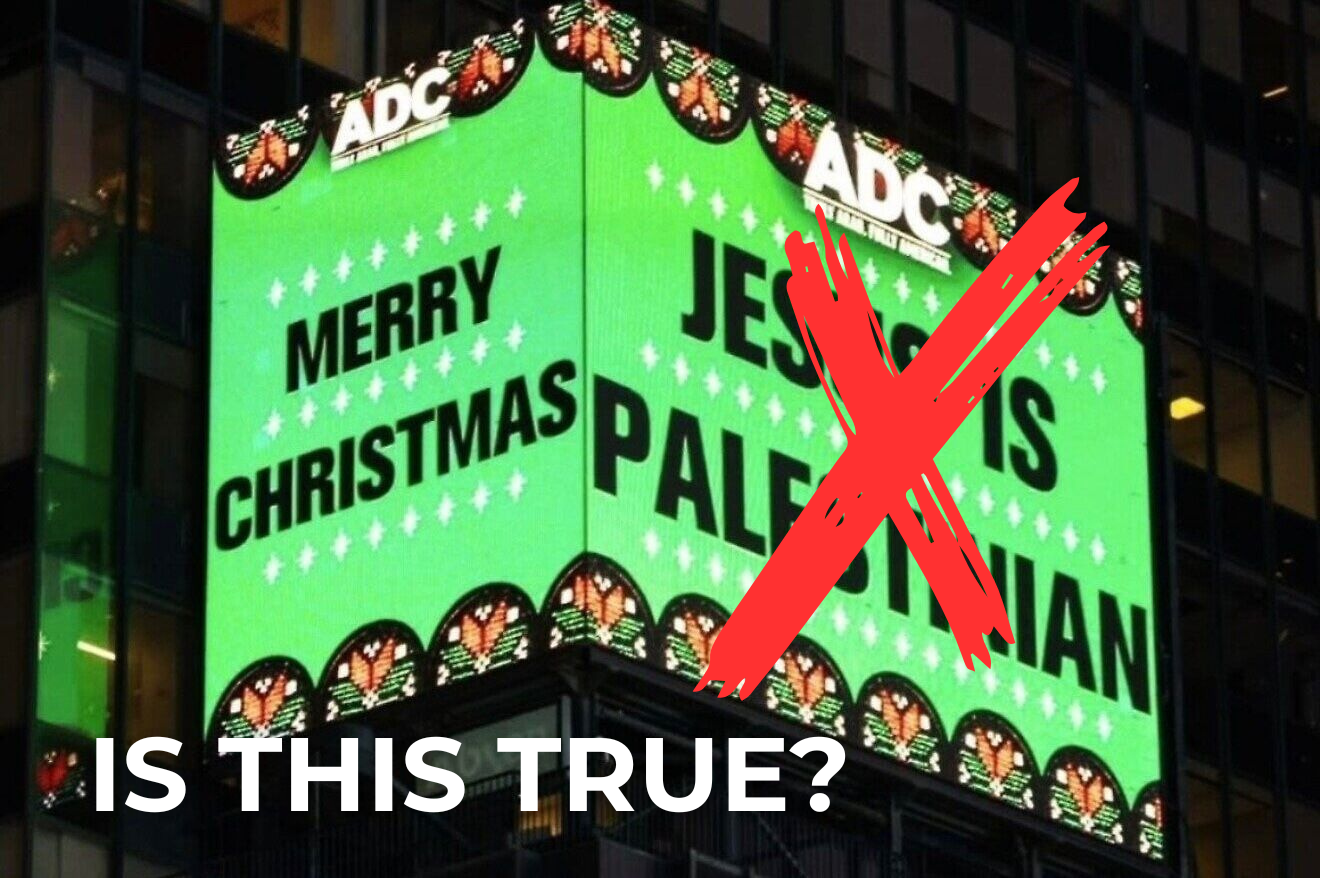
We wish to conclude this article with a final comment related to a widely viewed billboard that states, “Jesus is Palestinian”, which is both naive and deceptive; the hijacking of biblical principles and characters to serve Islamist extremist frameworks is unacceptable and intellectually dishonest. Any honest historical reckoning must affirm that Jesus of Nazareth was fully and irrevocably Jewish—born into a Jewish family, circumcised under Jewish law, worshipping in the synagogue, teaching from the Hebrew Scriptures, and living within first-century Judea long before the modern political term “Palestinian” existed. To detach Jesus from his Jewishness is not a neutral error but a distortion with consequences, because it creates space for theological and ideological narratives that erase Jewish continuity in the land and in history. Within certain Islamist extremist frameworks , hostility toward Jews is not merely political but sacralised, drawing in part on later hadith traditions that are treated by some movements as binding and programmatic; when such texts are elevated to near-scriptural authority, they can function as warrants for contemporary antisemitism rather than as historically bounded apocalyptic material. In countries such as Iran, where Islamic law formally rests on the Qur’an interpreted through authoritative hadith and juristic tradition, these sources can carry real doctrinal and political weight, shaping rhetoric far beyond the academy. Recognising Jesus as Jewish and recognising how certain religious texts are mobilised in the present, helps readers see that today’s rise in antiJewish sentiment is not accidental or merely reactive, but is often nourished by deep theological misreadings and ideological inheritances that must be named if they are to be resisted.
1 For example, the 1988 Hamas Charter, Article 7, explicitly cites the following hadith: Sahih al-Bukhari 2926, Book 56, Hadith 139 – ‘Allah's Messenger (صلى الله عليه وسلم (said, "The Hour will not be established until you fight with the Jews, and the stone behind which a Jew will be hiding will say. "O Muslim! There is a Jew hiding behind me, so kill him." ‘
Dr Celeste Johnson is a Scholar Affiliate at Reasons to Believe Africa. She has her doctorate in theoretical physics.