War is Peace
Dr Celeste Johnson
In George Orwell’s classic dystopic novel, 1984, we are introduced to a world of “Doublethink,” as seen in the party’s slogans: "War is Peace," "Freedom is Slavery," "Ignorance is Strength"; in the novel’s Ministries’ functions: the Ministry of Peace wages war and the Ministry of Truth spreads lies with a constant rewriting of history - knowing well that a document is false while accepting it as true.
In our previous article, “Two Jesuses - light and darkness at the end of history”, we saw that, while the shrouded person named “Jesus” appears in both the Qur’an and the Bible, the fundamental characteristics defined within the respective texts in fact make the two characters diametrically opposed to and opposites of one another. The same is true for the eschatological function of the biblical Antichrist, the False Prophet and the Messiah. We contrasted these with the three eschatological characters of Islam, namely the Mahdi, Isa / Jesus and the Dajjal. Language is the only tool we have to communicate – hence the need to ensure we don’t succumb to “doublethink”.
It is thus crucial to provide different labels to fundamental characters (and words) which are common between the Bible and the Qur’an - but exhibit some form of diametric opposition, in true Orwellian style.
Love is a profound example of this doublethink. God’s love for humanity in the Bible is characterised by the word “agape” which is considered the highest form of love; it is selfless, sacrificial, and unconditional love. The Jewish God loves the whole world (while they are still sinners / evil-doers) so much, that He gives them Heaven’s best, His Jewish Son Jesus. In contrast, Allah’s love for humanity is encapsulated in the word “yuhibbu”; Allah gives love to Islamic believers provided they follow and obey both him and Muhammed. It is striking that his love can be taken away (being ‘replaced’ by other followers of Islam) if, for example, such persons do not do what is expected of them. Crucially, there are many Qur’anic verses where “Allah does not love” - people who display displeasing traits such as eating too much. It would be Orwellian to equate unconditional, unearned, personal, “agape” love with uncertain, hard-earned, distant “yuḥibbu” (see Appendix A for a more in-depth discussion).
Similarly, for the love between our neighbours, there is a highly insightful and fundamental difference. The Bible teaches that all our relationships with other people, whether friend or foe, should emanate from a core of sincere and unconditional love, as exemplified in the life of the Jewish Jesus. Believers in the Qur’an, however, are not encouraged to form deep friendships with non-believers. Indeed, Imam Ibn Hajar Asqalani interprets Qur’an 3:28 as follows: “the meaning of this verse is that no believer shall befriend an unbeliever either internally or externally … It is permitted to befriend him if he is afraid of them but he must keep enmity from them internally.” This feels eerily akin to an Orwellian type of slogan: perhaps “Friendship is Enmity” (see Appendix B).
The two faiths differ radically, too, in terms of martyrdom.
The biblical version of martyrdom always comes from a place of love and forgiveness. The very first martyr in the New Testament was effectively Jesus, who was given the death sentence for claiming to be God (see Appendix C). A key aspect of Jesus’ martyrdom was that he had the means to physically protect himself from persecution and oppression, but he did not use this; instead, He chose rather to be an “archetypal martyr” (see Appendix D).
Thus begins the Christian history of archetypal martyrdom, which was always pacifist in nature. Tertullian famously quoted that “the blood of the martyrs is the seed of the church” which describes the paradox that the Christian faith grows particularly vigorously in the face of regimes which aim to exterminate it. Let us recall the period 284 - 305 AD, where as many as 3,000−3,500 Christians were executed under the authority of the Roman Emperor Diocletian (see Ref [1]). A people doomed to extinction suddenly had a dramatic turnaround when Constantinople unexpectedly converted to Christianity and issued a decree granting religious tolerance, ended the persecution of Christians and restored confiscated property. This trend extends to the present - the blood of the martyrs is still the seed of the church. Christianity continues to grow fastest in countries where persecution (and potential martyrdom) is the greatest. This is reminiscent of Jesus’ instruction in Matthew 5:38-39, “You have heard that it was said, ‘An eye for an eye and a tooth for a tooth.’ But I tell you not to resist an evil person. But whoever slaps you on your right cheek, turn the other to him also.”
Islam, on the other hand, recommends tit-for-tat retaliation; for example, Qur’an 2:191 states, “And kill them wherever you overtake them and expel them wherever they have expelled you, and fitnah is worse than killing. And do not fight them at al-Masjid al-Haram until they fight you there. But if they fight you, then kill them. Such is the recompense of the disbelievers” (italics: mine). The reference to fitnah refers to followers of Islam being persecuted or to having their core beliefs challenged. If one downloads a Qur’an app and simply searches the word “kill”, one alarmingly finds numerous instances where killing of unbelievers is encouraged. Furthermore, should Islamic-believers feel uncomfortable in joining this fight, such would be dissuaded from backing down – and encouraged by verses such as Quran 2:216: “Fighting has been made obligatory upon you ˹believers˺, though you dislike it. Perhaps you dislike something which is good for you and like something which is bad for you. Allah knows and you do not know.” This verse is truly another eerily Orwellian concept – as if it is good to do something that your conscience warns you is evil. The Islamic concept of a martyr, then, is that of “dying in the way of Jihad”. These two versions of martyrdom occupy opposite ends of the spectrum and are a clear example of doublespeak.
It is important to recall that the method of propagation of the two faiths in the first few centuries after their existence, were diametrically opposed. It is well-known for example, that, unlike the pacifist martyr propagation of Christianity, Muhammed initiated and participated in 80-armed missions and battles (see Appendix E).
Is the understanding of the concept of war, universal? No! A concept developed in the Abbasid era of 750 - 1258 AD purported that the world is divided into the Dar Al-Islam (the house of Islam – Peace - typically where Shariah Law prevails), and Dar al-Harb (the house of War) (see Appendix F). The latter were lands that were not under Islamic rule and were considered potentially hostile to the spread of Islam. This was curiously conducted through two main avenues - Dawah (by invitation) or alternatively, embracing the dreaded word Jihad (struggle).
Such methodologies have one single focus: to bring those lands under Islamic sovereignty.
Jihad war is the outright physical and mental form we are all familiar with, especially after the events of October 7. Dawah is the no less dangerous form, being the “Trojan Horse” method of defeating an enemy from within.
In 628 – 629 AD, Muhammed sent Dawah invitations to more than 6 neighbouring countries to ‘accept’ Islam (with Muhammed as the most important prophet) ‘or else’. These countries included Rome, Persia, Ethiopia, Egypt, Damascus, Bahrain and Yamama. If the Dawah was rejected with a polite “no thanks, I don’t want your religion or to be brought under submission to you”, the only alternative was Jihad (Struggle). Modern Muslim scholars understand this to be “primarily defensive, a means to protect the Muslim community or respond to aggression, not forced conversion.” However, Orwell would quickly point out that, in light of the awful consequences, the word “choice” is hardly what one might think of that word:
Perhaps this: Freedom of will is rather, enforced Islamic will.
It is important to note that the process of Islamisation has not changed – only the relative proportion of Dawah with respect to Jihad. Early Islamisation could afford to rely mostly upon Jihad - due to massive military strength and sheer numbers. The overthrow of Constantinople by Islamic forces is correctly described as a human tsunami. Since the 1950s, however, Islamisation has needed to rely primarily on Dawah – the call or ‘invitation’, with relatively smaller doses of the poisonous Jihadic shows of military power. Dawah is truly a full-on method of war – think of it as “war by peace”, with Dawah as the invitation to let in the Trojan Horse (see Appendix H).
Immigrants also serve to promote Dawah by demonstrating good character (sparking interest in non-Muslims), building Islamic centres, contributing to charities and distributing Islamic educational material.
Muammar Gadaffi, the late Libyan dictator, stated in 2006 (the sections in italics are mine):
“We have 50 million Muslims in Europe. There are signs that Allah will grant Islam victory in Europe - without swords, without guns, without conquests. The fifty million Muslims of Europe will turn it into a Muslim continent within a few decades. Allah mobilizes the Muslim nation of Turkey, and adds it to the European Union. That's another 50 million Muslims. There will be 100 million Muslims in Europe. Albania, which is a Muslim country, has already entered the E.U. Bosnia, which is a Muslim country, has already entered the E.U. Fifty percent of its citizens are Muslims. Europe is in a predicament, and so is America. They should agree to become Islamic in the course of time, or else declare war on the Muslims.” [10]
Islamic charities sometimes work side by side with Islamic immigrants – for example, one such charity (thought to have potential links to terrorism) is actually in South Africa. It recently used money, obtained via charitable channels (such as fast food optional donations and its stake in lottery proceeds), to fly more than 150 Palestinian refugees into South Africa. How diabolical – donors funding this organisation might have thought that it was for well-needed food relief in our country (for example see Appendix I).
Another very diabolical form of Dawah is that of infiltrating the education (and political / legal) system – as well as media outlets: any method to demonise Christianity and to glorify Islam.
Allow us now to focus on the map below, of Byzantine, a Christian empire – one of the empires to which Muhammed sent “invitation to convert or else” – the Dawah - in full force. Byzantine eventually fell entirely with the fall of Constantinople on 29 May 1453. At its height, this empire included the below-shaded modern countries (30 in total) as represented below Ref. [9]:
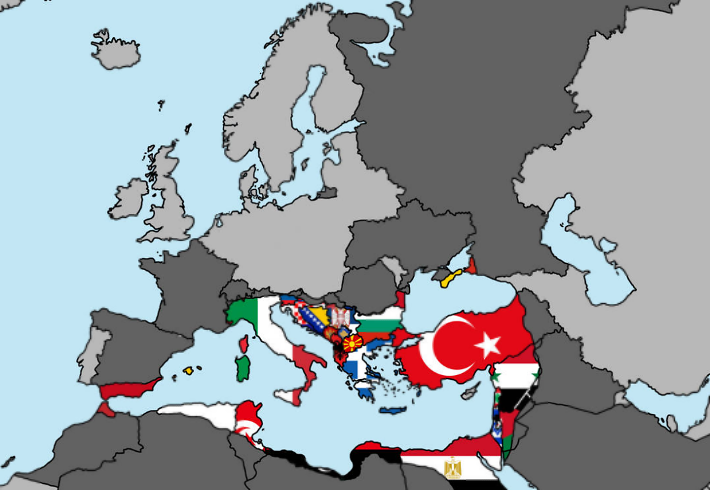
The Christian Byzantium Empire was an inspirational place of learning, known for its teaching of Law, Philosophy, Arithmetic, Geometry, Astronomy, Music, Rhetoric, Trivium with Grammar, Rhetoric and Dialectics, the Quadrivium with Arithmetic, Geometry, Music, Astronomy and Medicine. It functioned until the Ottoman occupation in 1453 when, after centuries of history, learning institutions were converted into Arab mosques and madrasas (teaching institutions that focused mostly on Islamic law and theology).
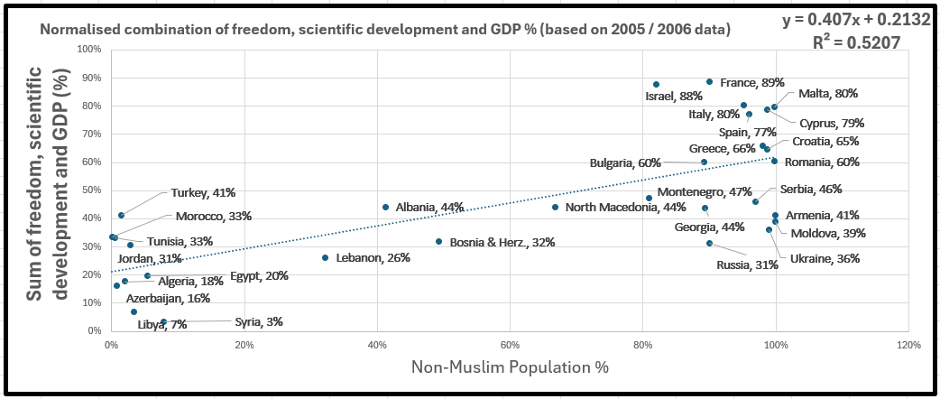
The countries in the Byzantium map above, all started with a similar impetus, having all been part of one empire. Today, if we plot the normalised combination of a country’s freedom, scientific development and GDP versus non-Muslim population percentage, we find the unsettling picture of what “Islamic freedom” truly looks like (see Appendix L for an explanation of the calculation). Freedom and prosperity becomes the inverse likelihood of living under Shari’ah Law and/or Islamic domination.
As we wind our path toward a conclusion, we dare not escape the rights of women under Islam. Byzantium was well ahead of its time in building a legal system: a complete revision of all Roman law undertaken by Justinian I (who served as Roman emperor and who reigned from 527 until 565 AD). This legal code - the Corpus juris civilis - has formed the basis of much of today’s legal code. This code, when compared with previous legal frameworks, had a particular focus on women’s rights and children’s rights.
Women were empowered by laws he passed, which included protecting prostitutes from exploitation and preventing women from being forced into prostitution; rapists were treated severely. Further, following the policies of the Corpus juris civilis meant that women charged with major crimes should be guarded women - to prevent sexual abuse; furthermore, if a woman was widowed, her dowry would then be returned to her; a husband could not take on a major debt without his wife giving her consent twice. The laws introduced by Justinian I also reflected a great concern for the interests of children, particularly those born out of wedlock, as well as matters involving child neglect [6].
In stark contrast are countries where Shari’ah Law has taken a stronghold or strangle-hold of society – where a thief’s hands must literally be cut off (Qur’an 5:38); where an adulterer / adulteress (but in practice, it is more often the adulteress) must receive one hundred lashes (Qur’an 24:2); where a wife is the “tilth” of her husband and where he has the right to potentially rape her whenever he wants (Qur’an 2:223). Women have no choice but to be covered (Quran 33:59). Ref. [5] delves into the lived experience of women’s rights under Shari’ah Law. Do women have freedom in these societies? Perhaps Orwell might say that freedom in such societies is slavery?
Slavery to ideology. The concept of honour-killing is not found in some obscure Haddith or Commentary, but rather in the Qur’an itself (Qur’an 18:74, 80,81)!
Islamic-Moses was walking with a servant; the servant killed an innocent boy, for which Islamic-Moses was shocked: "So they proceeded until they came across a boy, and the man killed him. Moses protested, 'Have you killed an innocent soul, who killed no one? You have certainly done a horrible thing.'".
The servant then explains himself – justified in true Orwellian style:
“And as for the boy, his parents were believers, and we feared that he would overburden them by transgression and disbelief. So we intended that their Lord should substitute for them one better than him in purity and nearer to mercy.”
Is murder really mercy?
Appendix K shows how various Artificial Intelligence engines today effectively legitimise the Quranic verses on honour killings.
Has the Dawah trojan horse war tactic already infiltrated our “Ministry of Truth” – Artificial Intelligence? Is it spreading dangerous lies in the name of truth? I hope not.
I encourage the reader to think carefully about whether he or she would (under force, verbally or otherwise) submit to Islam and its prophet – and either falsely convert or live as an “Islamic-protected” Dhimmi, or fight to ensure the freedom of generations to come.
Constantinople knew this. This city had been the “centre of the world” economically, and it was the capital of the Christian world. Until its fall to the Turks in 1453.
To crush the truths as expounded by Jesus, the Turks set their eyes on Rome – but to get there, they first needed to defeat Vienna. After a failed initial attempt to defeat Vienna in 1529, they set to work meticulously planning their great conquest, and on 14 July 1683, began their siege of Vienna which was to last nearly 2 months.
But Buried Truth always resurrects!
Blessed Marco d'Aviano, a Capuchin friar and papal legate, rose to the occasion and was instrumental in forming the Holy League, uniting Catholic forces against the Ottoman threat, and served as a spiritual beacon for the Christian army.
His hallmark speech:
"Soldiers of Christ! Before you lies an enemy seeking to extinguish the light of our faith and conquer our lands! The Holy Father sends his blessing, and God Himself promises victory to those who fight with courage and trust in His divine protection. Carry the Cross, defend your homes, your families, and all of Christendom! … let the cry of 'God is our aid!' ring out as you charge into battle, for today, through God's grace, we shall triumph!".
The date was 12 September 1683 – may we ever live in that day! If it were not for Blessed Marco, we may have already been consigned to the dystopic landscape of “1984”.
Orwell warned us that when words lose their meaning, people lose their minds. Chesterton would have added that they soon lose their souls as well. “War is Peace” is not merely a slogan of tyranny; it is the final triumph of muddled thinking, the moment when a society becomes too weary to notice that it is swallowing its own contradictions. The danger is not only political but profoundly spiritual: a civilisation that cannot tell the difference between opposites will soon forget why opposites matter at all.
Chesterton often reminded us that the world is held together by real distinctions — light and darkness, mercy and justice, truth and falsehood. Erase the boundaries, and the world does not become broader; it becomes shapeless. Doublethink attempts exactly this: it dissolves the lines that give reality its form. It asks us to treat contradictions not as warnings, but as comforts; not as alarms, but as lullabies.
And yet, once a person accepts two opposing ideas simply because it is convenient, he or she has already surrendered the central fortress of his or her humanity. For the human mind was not made to bow before nonsense. It was made to seek truth, and truth — real truth — refuses to wear two faces.
Chesterton would remind us that sanity begins with the courage to say “No” where the world demands a polite “Yes.” To insist that war is not peace, that words mean what they mean, and that contradictions cannot coexist simply because an authority figure prefers them that way — this is not stubbornness, but sanity. It is the cheerful defiance by which free people, and free faiths, remain free.
In the end, resisting doublethink is not merely an intellectual duty but a moral one. For when we protect the integrity of language, we protect the integrity of truth itself — and with that, the integrity of the human soul.
References
[1] Frend, William H.C. Martyrdom and persecution in the early church: a study of a conflict from the Maccabees to Donatus. New York University Press, 1967. Reissued in 2008 by James Clarke Company, U.K. ISBN 0-227-17229-9, pp 393 - 394
Liebeschuetz, J. H. W. G. Continuity and Change in Roman Religion. Oxford: Oxford University Press, 1979. ISBN 0-19-814822-4, pp 251 – 252
[2] Brother, Marko. 2017. The Tale of two Houses examining the offensive of the House of Islam to dominate the house of Infidels By Brother Marko Published by the EGEIRO Ministry. South Africa
[3] Acosta Güemes, L., Cusumano, A. M., & Giménez Milán, C. (2023). Institutions of Higher Education from the Beginnings of Civilization to 600 AD. Asian Journal of Education and Social Studies, 46(3), 29-40.
[4] Freedom House (2025). Freedom in the World 2025: The Global State of Political Rights and Civil Liberties. freedomhouse.org
WIPO (2025). Global Innovation Index 2025: Innovation in the Face of Uncertainty. World Intellectual Property Organization. www.wipo.int
Pew Research Center (2025). Religious Composition by Country, 2010-2050. https://www.pewresearch.org/religion/2015/04/02/religious-projections-2010-2050/
IMF (2025). World Economic Outlook Database: October 2025. International Monetary Fund. www.imf.org
Britannica (2025). Byzantine Empire: History, Geography, and Modern Legacy. https://www.britannica.com/place/Byzantine-Empire
[5] https://www.fairplanet.org/story/3-countries-where-sharia-law-is-hardest-on-women/
[8] https://tinyurl.com/36r6apzb
[10] https://shorturl.at/47hB8, Hadith Volume 1, Book 6, Number 301